How to Design Smart Battery Monitoring Systems Using MAX17048
Introduction
Modern portable electronic devices have become increasingly dependent on rechargeable lithium-ion (Li-ion) and lithium-polymer (Li-Po) batteries. From wearable electronics and wireless sensors to industrial handheld equipment and medical devices, battery-powered products are expected to operate longer, charge faster, and provide users with accurate information about the remaining battery capacity.
However, simply measuring the battery voltage is no longer sufficient for modern battery-powered applications. The battery voltage changes nonlinearly during charging and discharging, making it difficult to accurately estimate the remaining battery percentage using voltage alone. As batteries age, their characteristics also change. Therefore, reducing the accuracy of traditional voltage-based battery estimation methods. This is where a battery fuel gauge IC MAX17048, comes into play!
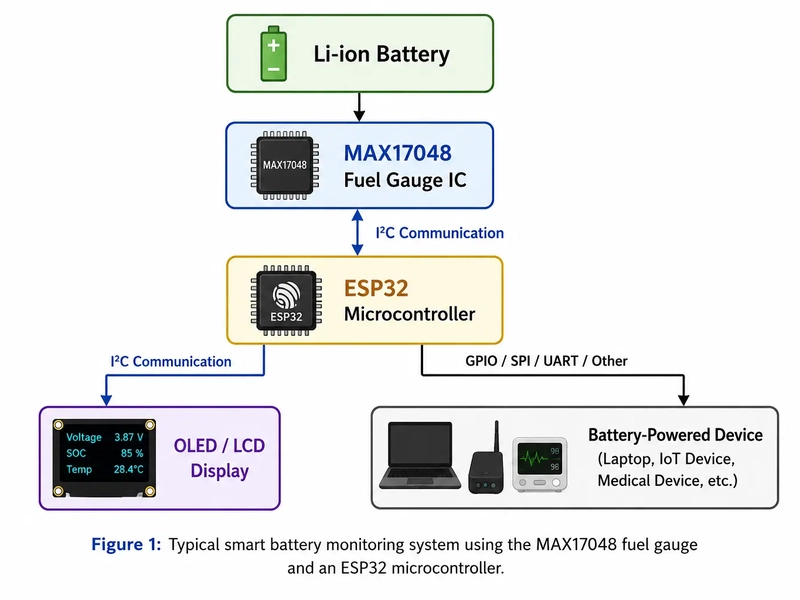
The MAX17048 is an ultra-low-power battery fuel gauge IC, which is used to estimate the State of Charge (SoC) of single-cell lithium-ion and lithium-polymer batteries. Due to its small footprint, low power consumption, and simple two-wire I2C interface, MAX17048 is widely used by design engineers for battery-powered embedded systems such as smart watches, smart glasses, and battery-powered earphones. It can be easily integrated with popular microcontrollers such as the ESP32, STM32, and Arduino using the I2C protocol. A simple block diagram of a battery-powered embedded system using a MAX17048 is shown below.