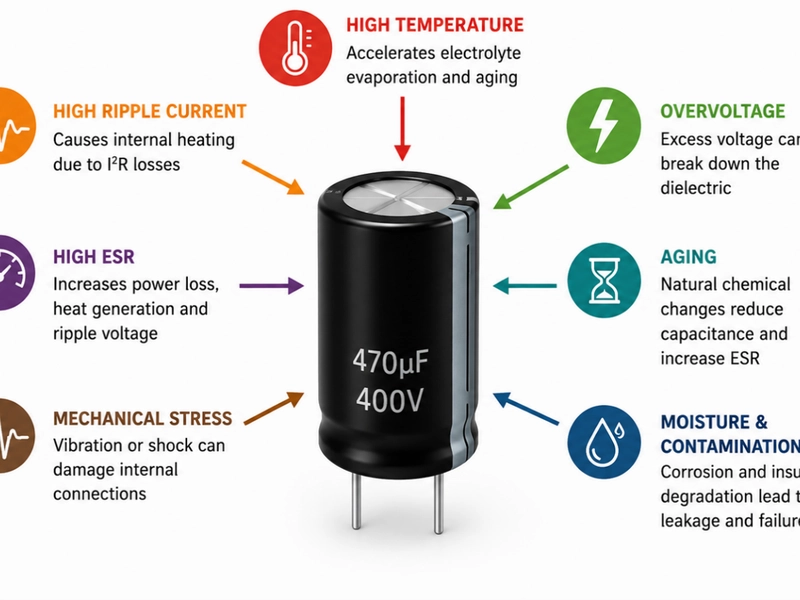
Why Capacitors Fail: ESR, Temperature, and Aging Explained
Introduction
Capacitors are among the most reliable components in electronic circuits. However, they are also among the most common sources of failure in electronic systems. Capacitors are widely used in electric vehicles (EV), switch-mode power supplies (SMPS), renewable energy systems (RES), industrial motor drives, and consumer electronics. They experience electrical, thermal, and mechanical stresses throughout their service life.
Before complete failure occurs, a capacitor often gives warning signs, Such as, its equivalent series resistance (ESR) increases, electrical characteristics gradually change, leakage current rises, capacitance decreases, and internal heating becomes more severe. All these changes lead to unstable converter operation, excessive output voltage ripple, reduced efficiency, and permanent damage to nearby components such as power semiconductors, and power controllers.
Therefore, identifying the root-cause behind the capacitor failure helps engineers to analyze the problem efficiently and improve circuit reliability. This guide discusses the most common causes of capacitor failure, including how temperature rise, ESR, ripple current, and aging affect the performance of the capacitor. In addition, warning signs of a failing capacitor, practical testing methods, and engineering techniques to extend the capacitor lifetime are explored.