
Resettable Fuse: Working, Types, Ratings, and Selection Guide
If you have ever pulled a blown fuse out of a USB port protector, a battery pack, or a control board and wondered whether there is a better way, there is. A resettable fuse does the same overcurrent protection job as a traditional fuse.
However, it does not need to be dug out and replaced every time it trips. It heats up, limits the current, then cools back down and goes back to work on its own.
That self-healing behavior is why resettable fuses, most often built as PPTC (polymeric positive temperature coefficient) devices, show up everywhere from phone chargers to automotive wiring to industrial control panels.
This guide walks through how they actually work, the different types you will run into, the ratings that matter when you are selecting one, and where they tend to trip people up in real designs.
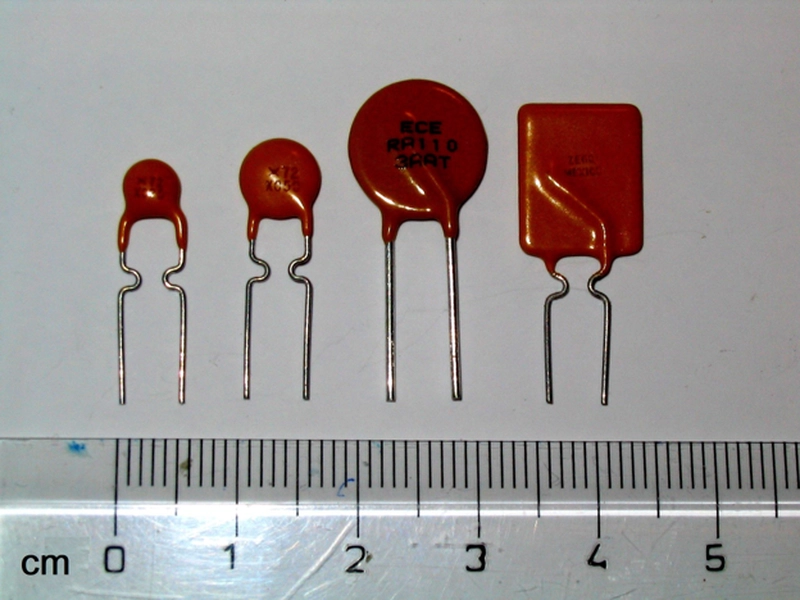
When current climbs past a certain point, usually because of a short, a wiring fault, or a downstream failure, the device heats up and its resistance jumps sharply, which chokes the current down to a safe trickle.
Once the fault clears and the device cools off, it returns to its low-resistance state and the circuit works normally again, no replacement required.
You will see this component called a few different names depending on the manufacturer or the datasheet: PPTC fuse, PTC resettable fuse, polyfuse, PolySwitch (a Littelfuse trademark), or multifuse. They all refer to the same underlying technology.
Physically, a PPTC device is built from a polymer loaded with conductive carbon black particles.
At normal temperatures, the polymer sits in a crystalline structure that traps the carbon particles into millions of tiny conductive chains, so current flows freely.
When the current gets high enough to heat the polymer past a threshold, the material expands and shifts to an amorphous state, which breaks apart those conductive chains and sends resistance climbing fast.
That is the whole trick: it is a mechanical and thermal phase change, not a melting wire like a traditional fuse.